
Reviving tradition: The art of rattan weaving in Rudong, Jiangsu
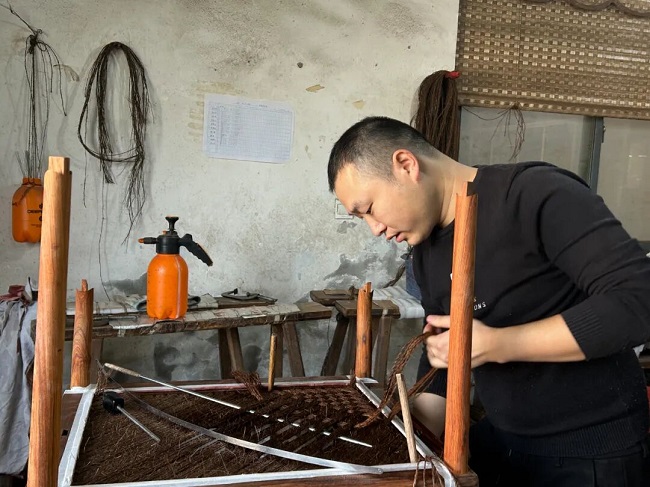
Xiao Xinjian, a rattan weaving artisan in a small village of Congjiaba, Rudong county, works at his workshop. [Photo/WeChat account: rudongfb]
In a small village of Congjiaba, Rudong county in East China's Jiangsu province, a centuries-old craft is being revitalized. At the heart of this revival is Xiao Xinjian, a rattan weaving artisan.
After training under Nantong artisan Gu Yongqi, Xiao returned to his hometown in 2015 to establish a workshop called Xiao's Rattan Works, specializing in rattan mats and custom crafts.
The workshop walls are adorned with bundles of light-yellow rattan, sourced from Indonesia. Workers meticulously select only the finest rattan, ensuring uniform color and thickness. These handpicked materials are crucial for creating durable rattan mats often used in furniture.
A rattan mat's strength lies in its base layer, crafted from intertwined palm fibers that distribute pressure and protect against wear. Craftsmen measure, mark, and drill holes into wooden frames, threading dampened palm ropes that tighten as they dry, forming a resilient support network.
The weaving process, requiring patience and skill, involves intricate techniques of picking and pressing to create straight, evenly spaced patterns. Classic motifs like Chinese knots are woven into the fabric, while modern designs incorporate symbols of luck and prosperity, offering psychological and spiritual comfort.
Xiao is committed to preserving this ancient art, which has been listed as an intangible cultural heritage item in Rudong. He actively trains young villagers, passing on his expertise to over 50 apprentices. Their meticulous craftsmanship and high-quality products breathe new life into this ancient wisdom. Through their efforts, the art of rattan weaving continues to thrive, bridging the gap between tradition and modernity.