
Hai'an forges new development path through agricultural, industrial strength
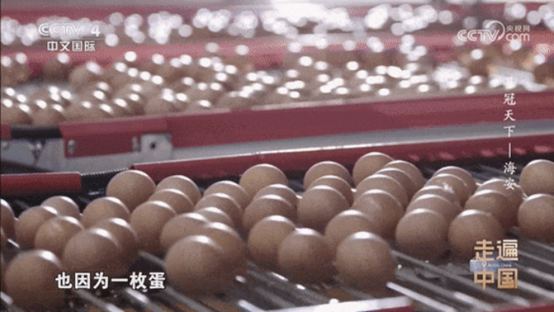
Hai'an in Nantong, Jiangsu, produces 700 metric tons of eggs daily. [Photo/WeChat account: hafbwx]
Known as a county-level city where agriculture and industry advance in tandem, Hai'an is reshaping traditional practices with technology, creating a distinct model for high-quality development.
Poultry farming has long been a source of prosperity for Hai'an residents. To overcome challenges such as weakened flock immunity caused by dense rearing, the city has transitioned to standardized henhouses and mechanized breeding. At its peak, one in every five eggs consumed in Shanghai came from Hai'an.
Hai'an has built a fully digitalized supply chain covering poultry farming, production, and processing. With 17 million laying hens, 21 large-scale modern farms, and a daily output exceeding 700 metric tons of fresh eggs, it has become the undisputed leader in Jiangsu's poultry industry.
Rice production tells a similar story of innovation. Hai'an has ranked first in Jiangsu for per-mu (0.067 hectare) rice yields for consecutive years, driven by digital farming technologies. In 2024, the city's digital farmland platform covered 409 family farms with 464,000 mu of cultivated land, boosting yields by 15 kilograms per mu while cutting costs by about 100 yuan ($14.04).
Hai'an is also China's largest producer of silkworm cocoons. Taking advantage of its favorable climate and soil, the city promotes family farms with subsidies of 1,000 yuan per mu of mulberry fields, alongside mechanization upgrades and under-mulberry economic models which include raising poultry and intercropping vegetables and medicinal herbs.
To date, 229 mulberry-silkworm family farms operate in Hai'an, each earning on average at least 300,000 yuan annually. Modernization has reached the silkworm workshops too, where silkworms now feed on formulated diets in climate-controlled, sterile facilities.
Hai'an has also pioneered artificial breeding and aquaculture of the Yangtze River pufferfish, establishing China's only full industrial chain for this rare species. Today, 80 percent of China's pufferfish are produced in Hai'an.
Through digitalization, mechanization, and innovation, Hai'an is demonstrating how traditional agriculture can integrate with modern industry to deliver sustainable, high-quality growth.


 TRANSPORTATION
 EDUCATION
 HEALTHCARE
 USEFUL NUMBERS