
Nantong records nearly 4,000 wildlife species

Long-necked ardea purpurea is spotted in Nantong. [Photo provided by Tang Meiling to en.nantong.gov.cn]
May 22 marks the International Day for Biological Diversity. The ecology and environment bureau of Nantong in East China's Jiangsu province released the latest monitoring data, showing that Nantong currently records 3,983 wildlife species.
These species include 94 species listed in the national key protected wildlife and plants, and 87 species listed as rare and endangered by the International Union for Conservation of Nature. The total number of species in the city has increased by 475 since 2019, with an increase of 194 species in just the past year.
From the sky to the land, from the Yangtze River to the Huanghai Sea, an intelligent observation network covering water, land, and air is recording the daily lives of creatures in Nantong around the clock.
The "sky network" integrates high-altitude satellite remote sensing and low-altitude drone inspections to conduct ongoing monitoring of vital ecological areas. This comprehensive approach ensures effective oversight of important environmental spaces.
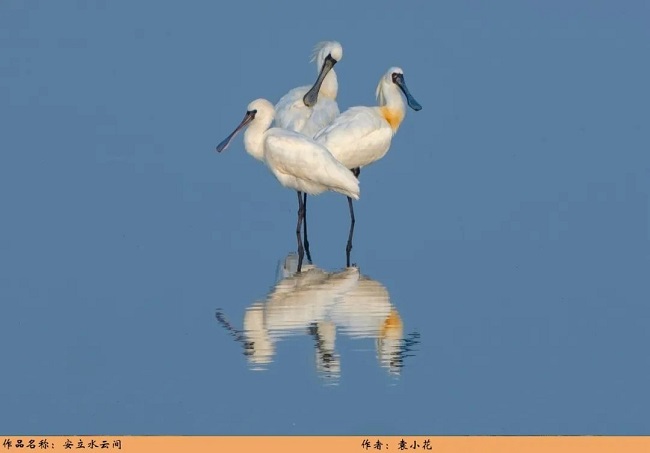
Waterfowl are spotted in Nantong. [Photo provided by Yuan Xiaohua to en.nantong.gov.cn]
The "land network" has established two biodiversity observation stations, set up 10 fixed biodiversity observation sites in the wild, four remote infrared camera monitoring points, 48 regular infrared camera monitoring points, 10 intelligent bird monitoring stations, and two intelligent bird sound monitoring points.
The "water network" has expanded its capabilities by deploying two Yangtze finless porpoise sonar intelligent monitoring boats in the riverside area, which have cumulatively monitored 10,139 times. Additionally, 50 environmental monitoring points have been established in the mainstream of the Yangtze River and its major tributaries.
In recent years, Nantong has explored the construction of "ecological islands" and systematically promoted key projects for biodiversity protection. The "ecological island" is not a real small island but a new model for ecological protection exploration in Jiangsu. Through scientific, active, and moderate artificial intervention, it provides a habitat suitable for biological habitation, reproduction, and migration.


 TRANSPORTATION
 EDUCATION
 HEALTHCARE
 USEFUL NUMBERS